Anomaly Factory 3D Diverse Pseudo-Anomaly Synthesis for Unsupervised 3D Anomaly Detection
Accepted to ECCV 2026
TL;DR: AF3AD is a pseudo-anomaly generator, not an anomaly detector: it manufactures diverse, controllable geometric defects on normal point clouds and returns synthetic anomalous samples plus masks for downstream training.
Abstract
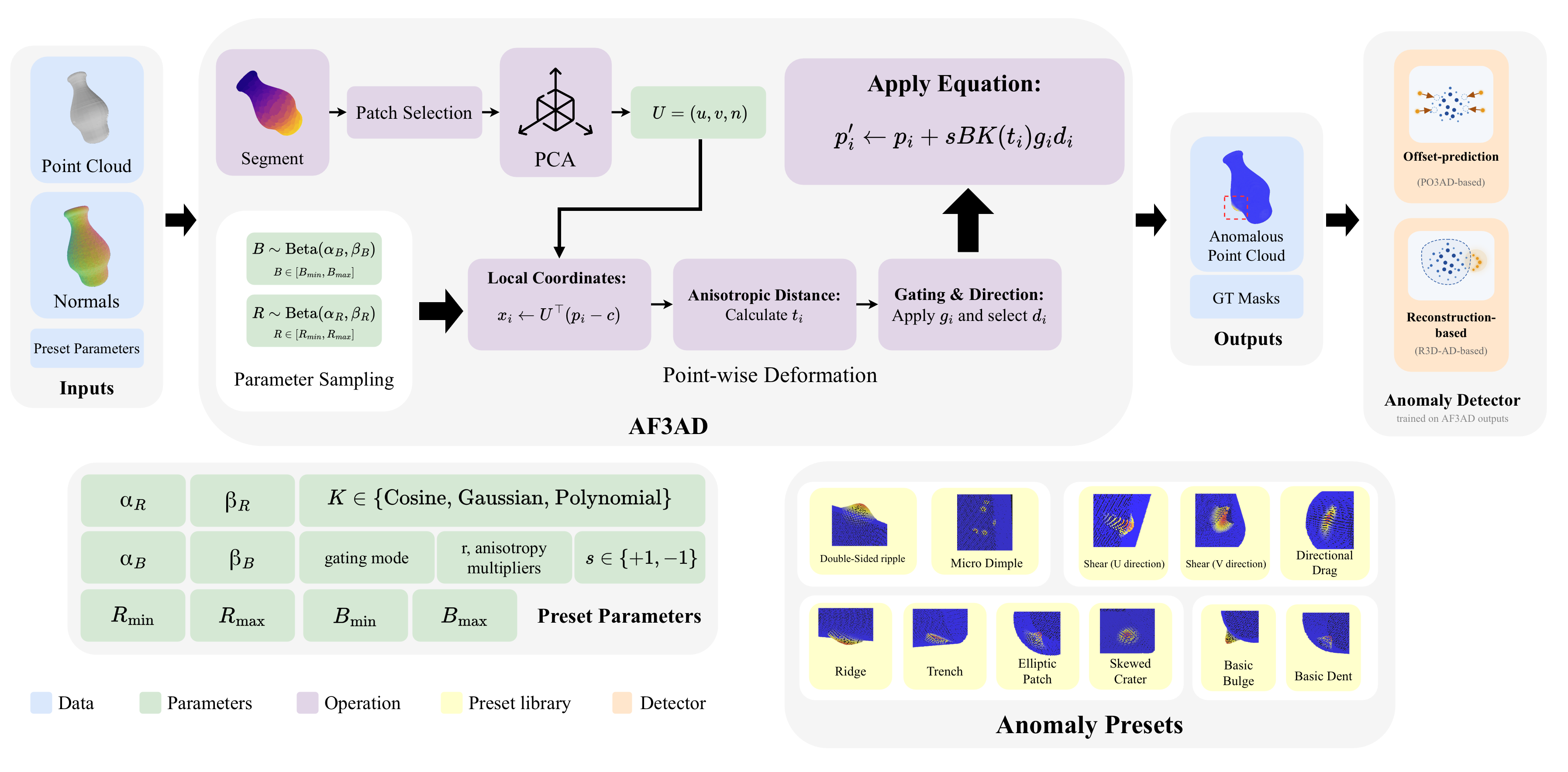
Detecting and localizing defects in 3D point clouds is challenging because abnormal samples are scarce and diverse, while training is often limited to normal data. We propose Anomaly Factory 3D (AF3AD), a modular framework that synthesizes diverse pseudo-anomalies from normal point clouds to expand the training data for unsupervised 3D anomaly detection methods that rely on pseudo-anomalies. AF3AD uses a center-conditioned parametric deformation model defined in local PCA frames, with kernel-controlled spatial falloff, anisotropy, directional gating, and normal/tangential displacement fields, enabling a broad set of geometric defect presets. We demonstrate its ease of use and effectiveness by integrating AF3AD with an offset-prediction detector and a reconstruction-based anomaly detection method, showing that AF3AD transfers across detection paradigms. Experiments on AnomalyShapeNet and Real3D-AD show consistent improvements in object- and point-level detection and localization, supported by ablations on preset groups and robustness under noise. AF3AD is designed as a standalone synthesis tool to facilitate adoption across different 3D anomaly detection paradigms.
How it works
From a normal point cloud, AF3AD samples a local segment, builds a PCA frame at the anomaly center, shapes a smooth falloff with a spatial kernel, and displaces each point along a selected normal or tangent direction.
Choose a local frame
Partition the cloud into 64 patches, sample a center, and estimate tangent axes u, v and normal n using local PCA.
Shape the affected region
Use kernel falloff, anisotropy, soft gating, radius, and magnitude to define a plausible defect footprint.
Deform and supervise
Move points along normal or tangential fields while retaining the generated point-wise anomaly mask.
p′ = p + s · B · K(t) · g · d
The presets in the demo are curated points in this parameter space; free explore exposes the raw knobs directly. In the synthesis module, magnitude and radius are sampled from bounded Beta distributions, giving each preset controlled stochastic variation.
Synthesis library
Eleven geometric defects under one formulation
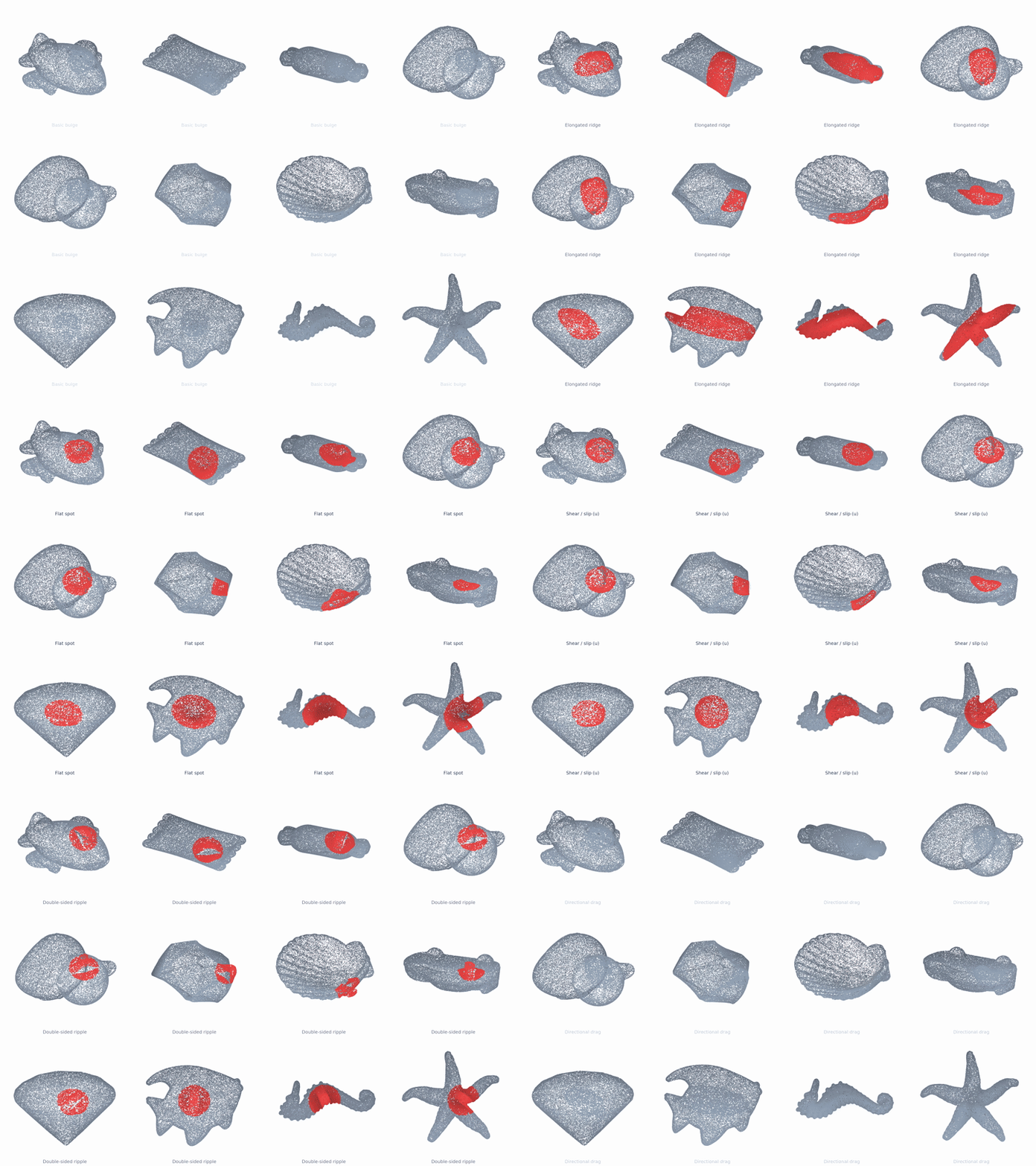
AF3AD unifies isotropic, anisotropic, asymmetric, periodic, and tangential surface changes in a single center-conditioned deformation model. The output is a library of generated pseudo-anomalies and masks, giving downstream detectors a broader set of abnormal cues than generators limited to only bulges and dents.
ANormal single-lobe
Basic bulges and dents: the simple normal-direction deformations that match common pseudo-anomaly baselines.
BStructured marks
Elongated ridges, trenches, flat spots, and skewed impact craters with anisotropic support and directional gating.
CCompound patterns
Double-sided ripples and micro-dimple fields that expose the detector to repeated or multi-frequency geometry changes.
DTangential shifts
Shear, slip, and directional drag presets that move points along tangent directions instead of only along normals.
Design intent: AF3AD is modular by construction. New presets can be added by choosing a kernel, anisotropy, sign, gating rule, and displacement direction within the same shared deformation formulation.
Results
Downstream detectors benefit from richer pseudo-anomalies
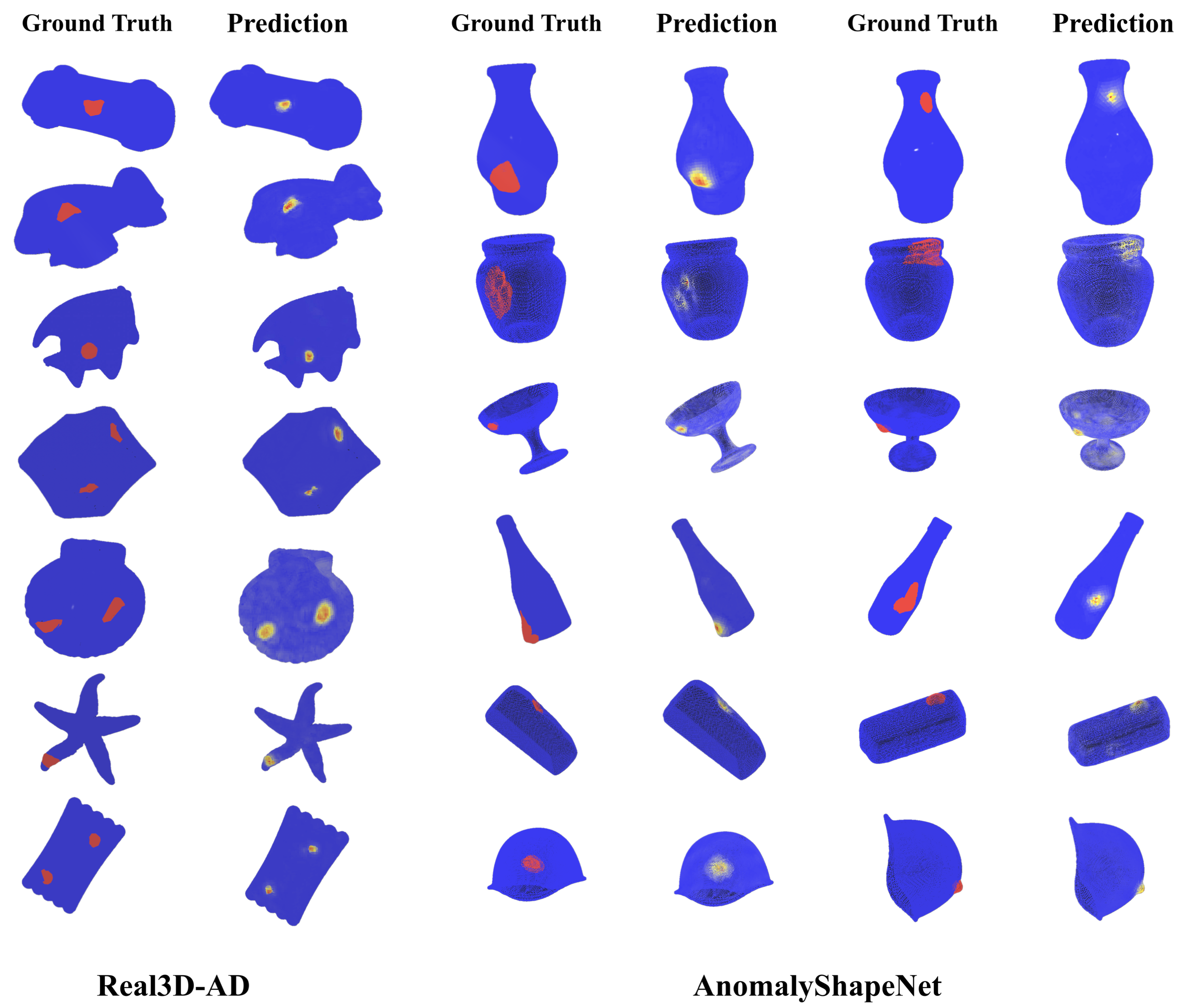
Across AnomalyShapeNet and Real3D-AD, detectors trained with AF3AD-generated samples improve object-level detection and point-level localization over strong pseudo-anomaly baselines.
Comparison with strong baselines
| Dataset | Method | O-AUROC | P-AUROC |
|---|---|---|---|
| AnomalyShapeNet | PO3AD | 83.9 | 89.9 |
| AnomalyShapeNet | Reg2Inv | 86.0 | 88.2 |
| AnomalyShapeNet | PO3AD trained with AF3AD samples | 91.5 ± 2.1 | 92.5 ± 1.6 |
| Real3D-AD | PO3AD | 76.6 | — |
| Real3D-AD | Reg2Inv | 78.1 | 87.9 |
| Real3D-AD | PO3AD trained with AF3AD samples | 85.2 ± 1.2 | 86.1 ± 1.9 |
Dash indicates that the metric was not reported for that baseline in the manuscript comparison table.
Modularity with reconstruction-based detection
| Setting | Downstream detector | O-AUROC | P-AUROC | Takeaway |
|---|---|---|---|---|
| AnomalyShapeNet, 15 classes | R3D-AD trained with AF3AD samples | 67.2 | 60.7 | +4.5 O-AUROC over the Patch-Gen instantiation. |
Ablations
Diversity is the useful signal
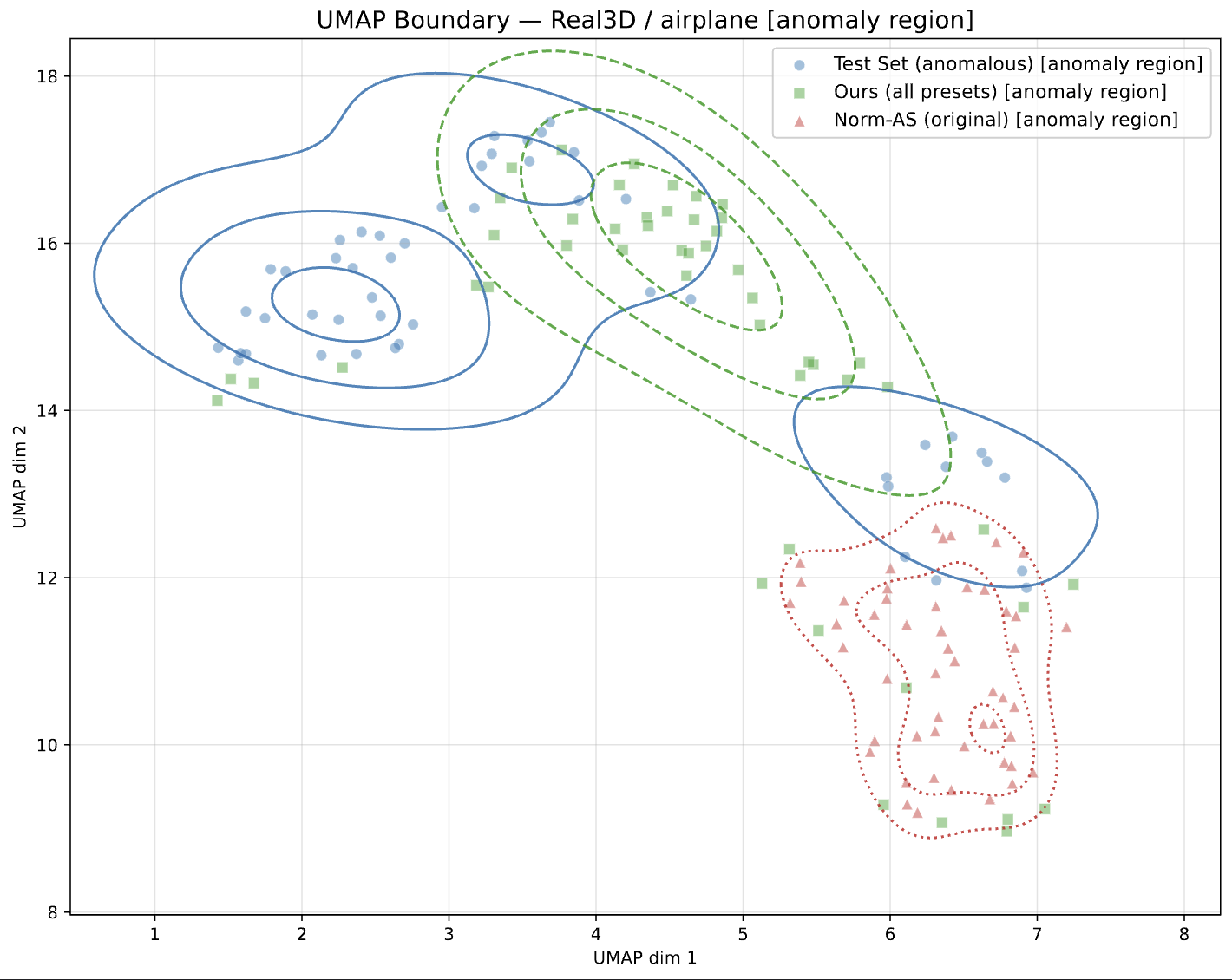
The manuscript separates detector architecture changes from synthesis changes. Under the matched multi-head offset predictor with hidden size 128, Norm-AS reaches 91.6 / 88.9 O/P-AUROC on the 15-class AnomalyShapeNet split, while the same detector trained with AF3AD-generated samples reaches 97.0 / 93.6.
Preset groups compound
Combining groups A-D outperforms single-group synthesis, showing that downstream detectors benefit from broader generated defect coverage.
Noise robustness holds
Mild Gaussian jitter leaves performance essentially unchanged; stronger noise mainly affects fine point-level precision.
Scope
What AF3AD models
AF3AD is designed for geometric surface defects in point clouds: bulges, dents, ridges, trenches, shear, drags, flat spots, and related smooth deformations. It directly modifies geometry and therefore does not model purely appearance-based or material defects. It also does not perform anomaly detection by itself; detection is handled by whichever downstream model consumes its generated samples.
Sharp cracks, scratches, and very high-frequency damage are only partially covered by the current smooth-kernel presets. The manuscript treats this as a limitation and leaves dataset-guided preset selection and richer generative synthesis as future work.
Citation
@misc{balapour2026anomalyfactory3dmodular,
      title={Anomaly Factory 3D: A Modular Framework for Diverse Pseudo-Anomaly Synthesis in Unsupervised 3D Anomaly Detection},
      author={Ali Balapour and Faraz Hach},
      year={2026},
      eprint={2606.29181},
      archivePrefix={arXiv},
      primaryClass={cs.CV},
      url={https://arxiv.org/abs/2606.29181},
}